
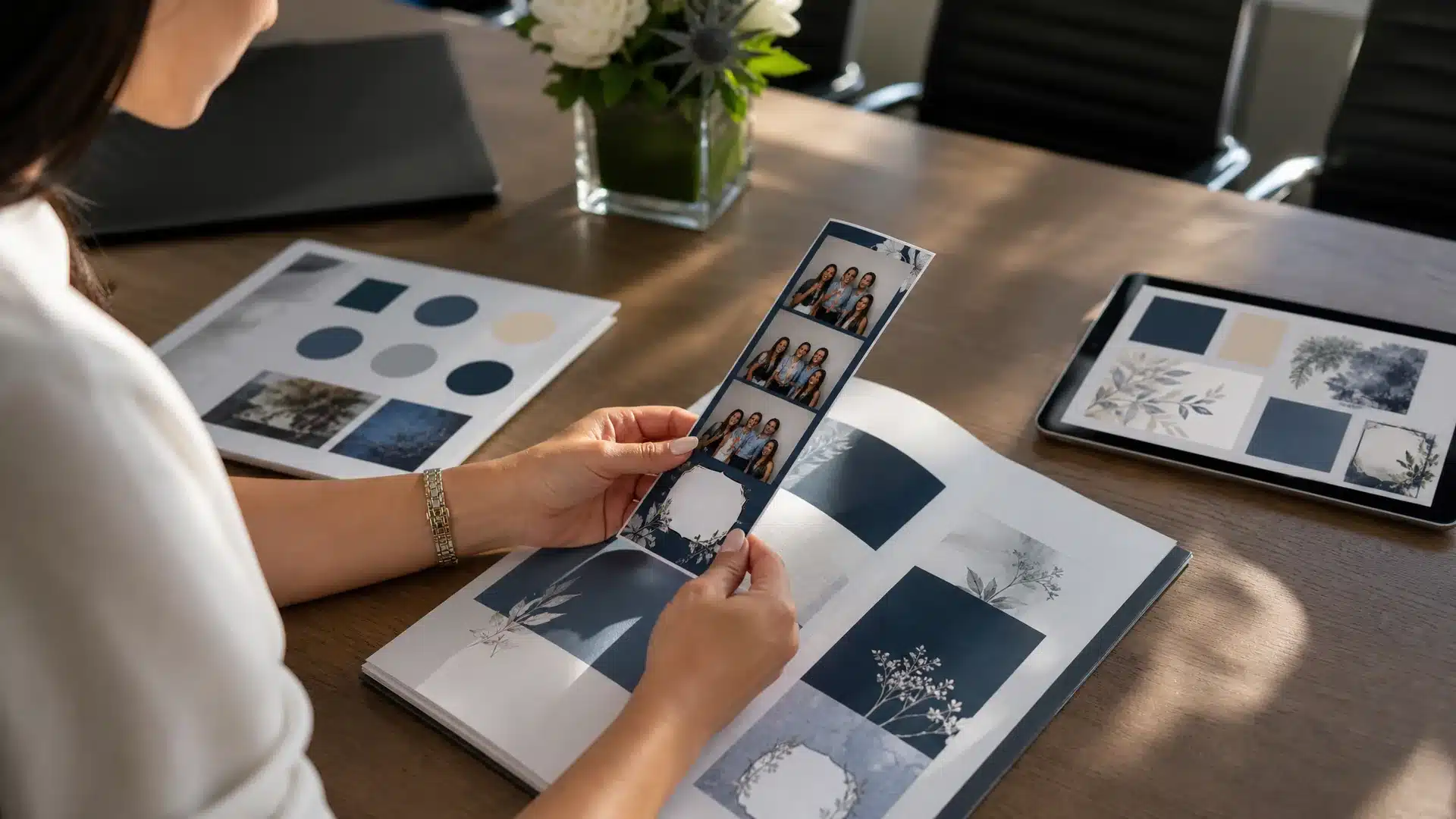
Branded Photo Booth for Corporate Events: Planning Guide
Warning: Attempt to read property "ID" on false in /home/u862242046/domains/phillyphotobooths.com/public_html/wp-content/themes/yootheme-1/packages/theme-wordpress/functions.php on line 83
Warning: Attempt to read property "display_name" on false in /home/u862242046/domains/phillyphotobooths.com/public_html/wp-content/themes/yootheme-1/packages/theme-wordpress/functions.php on line 85
Corporate planners booking a photo booth for a conference, product launch, or campus event usually run into the same gap: most vendor sites talk about props and prints but say almost nothing about brand assets, overlay approvals, or the paperwork procurement will ask for. A branded photo booth for corporate events involves all three, and buyers who plan for them upfront avoid delays in the week before setup day.
What Makes a Photo Booth “Branded” vs. Just Rented
A standard photo booth rental gives guests a generic template, a set of props, and a print with no company identity on it. A branded activation replaces that generic template with the company’s logo, colors, and event messaging on every print and digital share. The difference isn’t cosmetic. A rented booth is an entertainment add-on. A branded one is a marketing asset that reinforces the event’s messaging in every photo guests take home or post online.
Custom Overlay Photo Booth Basics
The overlay is the graphic layer placed around the photo: the frame, footer, and any decorative elements that carry brand identity. A custom overlay photo booth setup typically layers three elements: a logo lockup, a color-matched frame, and event-specific text such as a date, hashtag, or campaign name. Vendors build this overlay as a template file sized to match the booth’s print output, so the design has to be finalized before the event, not adjusted on-site.
Where Logo Placement Actually Matters
Logo placement affects both legibility and brand compliance. Placing a logo too close to the photo subject can obscure faces or crop awkwardly depending on group size. Most enterprise brand guidelines specify a minimum clear space and a preferred corner or footer position for lockups, and a vendor experienced with corporate accounts will ask for that guidance rather than guessing. Getting this right on the first proof matters more than it seems. Reprints or last-minute overlay edits eat into setup time on event day.
Building Your Brand Kit Before You Book
Vendors can’t build an accurate overlay without the right source files. A brand kit assembled before booking speeds up approval and avoids back-and-forth in the days leading up to the event.
Assets to Send the Vendor
A complete brand kit for a corporate branding event photo project usually includes:
- Vector logo files (EPS, AI, or high-resolution PNG with transparent background)
- Brand color codes in hex or Pantone format
- Approved fonts or a style guide referencing them
- Any required legal marks, taglines, or event hashtags
- A reference image or prior overlay example, if one exists
Common Brand Guideline Pitfalls
The most common delay is sending a low-resolution logo pulled from a website or slide deck, which prints blurry or pixelated on a physical strip. Another frequent issue is skipping the approval workflow: someone in marketing signs off on the overlay design, but legal or brand compliance never sees it, and changes surface the week of the event. Planners should confirm internally who has final sign-off before sending assets to the vendor, so the proof cycle only needs one round.
Overlay and Print Options for Different Event Types
Not every event needs the same overlay or print format. The right choice depends on how many people will use the booth, how fast prints need to turn around, and whether the goal is lead capture or internal morale.
Logo Photo Booth Prints for Conferences and Trade Shows
At conferences and trade shows, logo photo booth prints work best as a compact strip or postcard-size print that guests can carry around the show floor. A branded print in someone’s hand functions as a walking reminder of the booth. A layered overlay setup, with the logo lockup in a fixed corner, a brand color frame, and an event hashtag footer, lets a single template scale across a multi-day conference without reprinting for each session. For exhibitors focused on booth traffic and follow-up, using a photo booth for trade show lead generation pairs the branded print with a data capture step, so the activation does double duty as both engagement and pipeline.
Company Logo Photo Strip for Employee and Campus Events
Internal events, like employee appreciation days or campus recruiting fairs, tend to favor a company logo photo strip with a lighter overlay, often just a logo and event date, without heavy marketing copy. The goal here is closer to team morale and culture reinforcement than lead generation, so overlays can be simpler and print runs faster since there’s no need for QR-driven data capture on every strip.
Brand Activation Photo Booth Features That Drive Engagement
A brand activation photo booth earns its cost back through measurable engagement, not just entertainment value. Two features do most of that work: digital sharing and add-on activations that extend the photo beyond the print itself.
Digital Sharing and Post-Event Galleries
Instant digital delivery, via text, email, or a shareable link, lets guests post their branded photo to social channels immediately, extending the activation’s reach past the event floor. Branded photo activations are consistently among the highest-engagement booth elements at trade shows and conferences, since guests self-select into sharing the branded print or digital image with their own networks rather than being asked to. A post-event gallery, hosted and shared with attendees afterward, gives the brand a second engagement touchpoint days after the event ends.
AI Activation Add-Ons
Some vendors now offer AI-driven add-ons, such as automated background swaps or styled photo templates, layered on top of the same branded overlay. These features are worth asking about during vendor selection, but they should never come at the expense of overlay accuracy or logo placement. The brand elements are the deliverable procurement is paying for, and any add-on should support that, not distract from it.
Procurement Checklist for Corporate Buyers
This is the section most vendor pages skip, and it’s often where bookings actually stall. Corporate procurement and legal teams typically need a specific document set before they’ll clear a vendor, and asking for it early avoids a scramble the week before the event.
Documents to Request Before Setup Day
Full-service vendors typically supply a certificate of insurance (COI), a completed W-9, and a signed vendor agreement before setup day so that in-house procurement and legal teams can clear the activation without back-and-forth. Planners should also request:
- A formal invoice or quote outlining line-item costs
- Confirmed staffing details (attendant count, arrival time, load-in requirements)
- A written cancellation or rescheduling policy
- Overlay proof sign-off, in writing, before print production begins
Questions to Ask Vendors on the Discovery Call
Before booking, it’s worth confirming a few things directly with the vendor:
- Can you provide a COI naming our venue as additionally insured, and how quickly?
- What’s your standard turnaround for overlay proofs and revisions?
- Do you invoice net-30, or require a deposit and balance schedule?
- Who’s on-site the day of the event, and what’s the backup plan if equipment fails?
- Have you worked with enterprise brand guidelines or legal review processes before?
A vendor that answers these clearly, without hedging, is generally set up to work inside a corporate procurement process rather than around it. A corporate photo booth rental planning guide can help Philadelphia-area planners map these logistics against venue requirements and lead times specific to the region.
Choosing a Vendor for Multi-Site or Recurring Activations
Companies running a branded photo booth across multiple offices, campus locations, or a recurring conference series need a vendor who can maintain one brand kit and one overlay standard across every stop. That means centralizing brand asset approval once, then reusing the same template and print specs at each site instead of re-approving the overlay for every event. It also means confirming the vendor has the staffing and equipment capacity to cover multiple dates or locations without gaps in service.
Philly Photo Booths has executed branded activations for institutions including Penn Medicine, Villanova, Merck, Urban Outfitters, and the Philadelphia Museum of Art. That work has meant operating inside enterprise brand guidelines and procurement steps across a range of industries and event scales. For a company evaluating a branded photo booth for corporate events, whether it’s a single conference or a recurring multi-site program, the next step is requesting a quote that includes brand-kit setup, overlay proofing, and the procurement paperwork, COI, W-9, and invoicing, needed to clear internal approval without delay.