Corporate Event Photo Booth Checklist: Planner Confirmations

Corporate Event Photo Booth Checklist: Planner Confirmations


Warning: Attempt to read property "ID" on false in /home/u862242046/domains/phillyphotobooths.com/public_html/wp-content/themes/yootheme-1/packages/theme-wordpress/functions.php on line 83

Warning: Attempt to read property "display_name" on false in /home/u862242046/domains/phillyphotobooths.com/public_html/wp-content/themes/yootheme-1/packages/theme-wordpress/functions.php on line 85

Successful activations depend on administrative precision long before the first guest arrives for a picture. A corporate event photo booth checklist keeps branding, logistics, and compliance aligned with institutional standards, rather than leaving critical details to chance. This is the operational framework that separates a professional corporate activation from casual party entertainment, the procurement paperwork, the load-in schedule, the file specs that make or break a print.

Procurement and Compliance Documentation Checklist

Corporate procurement teams require verified documentation before any vendor can access a venue or receive payment. Having these materials prepared and formatted correctly prevents last-minute access denials at loading docks and avoids accounts payable delays that strain vendor relationships.

Certificate of Insurance and W-9 Requirements

Venues and corporate clients in the Philadelphia metro area consistently require a Certificate of Insurance with a minimum $1M in general liability coverage, plus a valid W-9, before they’ll allow load-in. The COI must list the hiring entity and often the venue itself as additionally insured parties. Coverage dates need to span the entire event window, including setup and teardown.

Tax documentation must match the legal business name exactly as it appears on banking records. A mismatch is enough to get an invoice rejected by an automated accounts payable system. Vendor compliance and procurement documentation covers the specific formatting and submission deadlines that larger institutions enforce. Philly Photo Booths has run activations for regulated clients including Penn Medicine and Merck, which means navigating exactly this kind of corporate procurement and safety documentation is routine, not a special request.

Vendor Contracts and Liability Clauses

Service agreements for corporate activations need clear scope boundaries, so change order disputes don’t erupt during a high-pressure event window. Contracts should spell out exact service hours, attendant counts, deliverable formats, and cancellation terms. Vague package descriptions invite interpretation conflicts later.

Liability clauses need to address equipment damage, data privacy breaches, and third-party claims, with indemnification language specific enough to satisfy corporate legal review. Experienced event planners tend to prioritize vendors who hand over detailed load-in schedules and union labor compliance documentation over vendors who show up with creative concepts alone, logistical failures, not weak design, are what actually derail activations.

Photo Booth Space Requirements and Venue Logistics

Physical footprint and power specifications determine whether an activation fits the floor plan without violating fire codes or blocking traffic flow. Confirming these technical parameters during site selection prevents costly day-of repositioning or equipment swaps that compromise the guest experience.

Floor Plan Dimensions and Power Access

Open-air setups typically need a minimum 10×10 foot footprint for the camera stand, lighting array, backdrop, and guest queue, without encroaching on adjacent exhibitor spaces or walkways. Enclosed booths need extra depth for the structure itself plus clearance for ventilation and ADA-compliant entry, often 8×12 feet or more, depending on the unit model.

Standard electrical needs include at least two dedicated 110V outlets on separate circuits. That separation matters: printers cycling at the same time as lighting rigs and computing equipment can trip a shared breaker. Verify outlet locations against the planned booth position before the event, not on the day of it. Extension cords running across high-traffic areas are both a safety hazard and visual clutter that undercuts the polished look the activation is supposed to deliver.

Load-In Timing and Venue Restrictions

Union labor rules at convention centers and major hotels frequently mandate that only certified technicians handle equipment movement above certain weight thresholds, or during specific time windows. Elevator reservations must be secured in advance for upper-floor activations, with freight elevator access scheduled separately from guest elevator banks so the two don’t collide during peak arrival.

Load-in windows often restrict vendor access to overnight or early-morning hours. That means staffing plans have to account for premium labor rates and fatigue during extended setup shifts. Missing these scheduling constraints by even thirty minutes can push the entire activation timeline back and force rushed testing, which raises the risk of a technical failure once guests arrive.

Brand Asset Preparation and Custom Overlay Specs

Brand consistency across printed and digital outputs starts with technically correct source files, submitted well before production deadlines. Building in buffer time for multi-stakeholder approvals avoids last-minute substitutions that degrade print quality or break brand guidelines.

File Formats and Resolution Standards

Print-ready overlays need vector-based PDF or EPS files with embedded fonts and CMYK color profiles, so colors match corporate brand standards accurately. Raster images like PNG or JPG need at least 300 DPI at final print size, anything less risks pixelation or banding under professional lighting.

Transparent backgrounds matter for overlay elements sitting atop a live camera feed, and layered source files let the team make quick contrast or saturation adjustments if venue lighting demands it. Custom overlay design specifications lay out the exact technical parameters that prevent the most common file rejections during pre-production proofing.

Corporate environments typically require sign-off from marketing, legal, and sometimes compliance before branded assets enter production. Building in ten to fourteen business days for that approval chain leaves room for revision cycles without compressing the vendor’s printing and testing schedule.

Legal review tends to focus on disclaimer language, trademark usage, and data capture disclosures, details marketing teams sometimes overlook during creative development. Rushed approvals raise the odds of an error reaching print, and that means expensive reprints or visible corrections that undercut the activation’s professional presentation.

Managing High-Volume Guest Flow and Staffing

Throughput capacity determines whether an activation enhances the event or creates a frustrating bottleneck during peak attendance. Staffing ratios and queue management have to scale to anticipated volume, since average traffic rarely holds steady across an entire event.

Throughput Rates and Queue Management

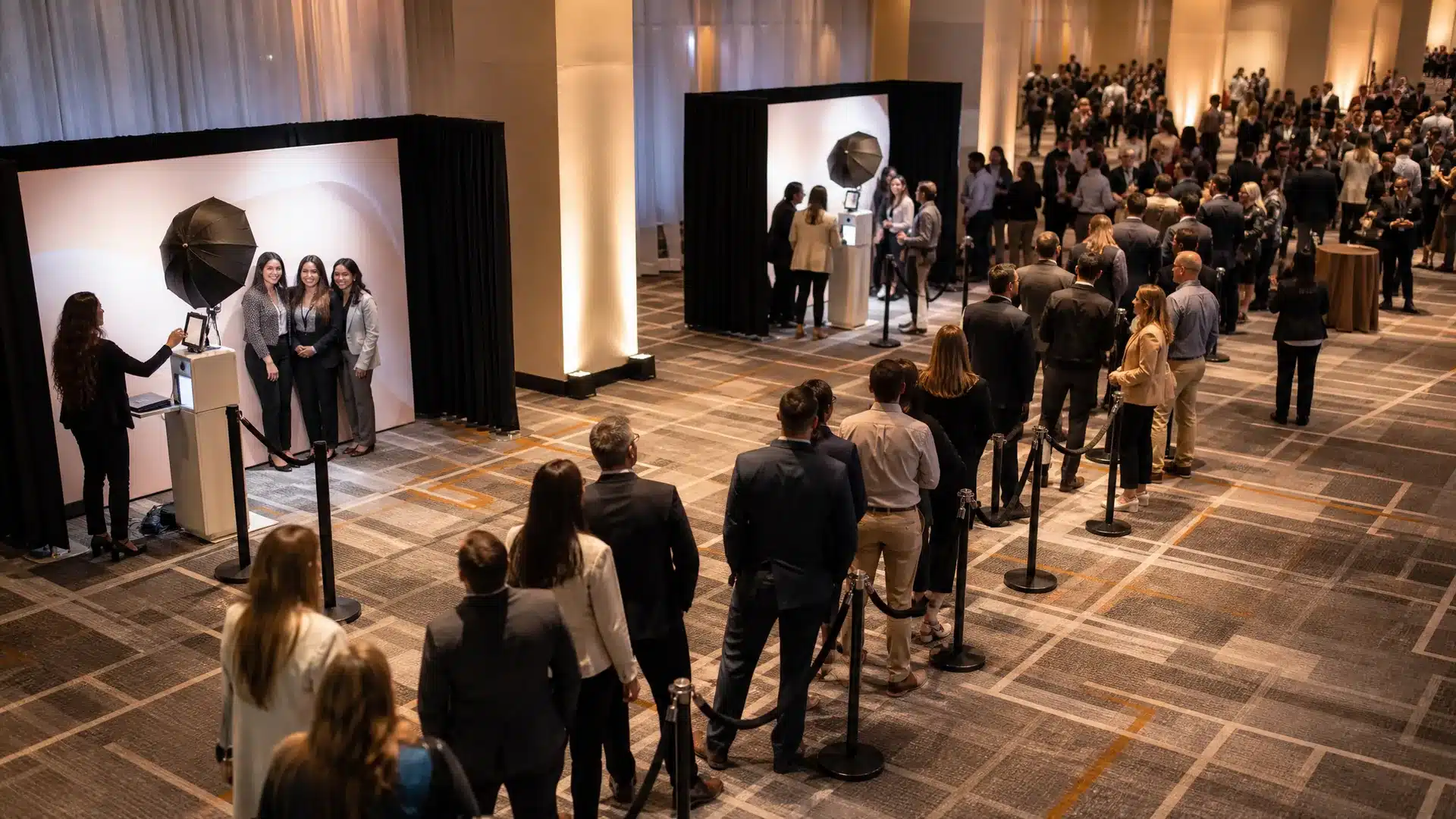
High-volume corporate events typically call for planning around 40 to 60 photo sessions per hour per booth, to keep pace with peak traffic during conference breaks or gala cocktail hours without a long line forming. That benchmark assumes an optimized workflow: attendants guide guests into position, trigger captures efficiently, and resolve minor technical hiccups without stopping the line.

Managing guest flow for large-scale activations covers how physical queue barriers, signage placement, and attendant positioning cut perceived wait times and keep crowds from spilling into adjacent event spaces. Underestimate peak demand by even twenty percent and the line becomes visible enough to discourage participation.

On-Site Attendant Roles and Break Schedules

Professional attendants do two jobs at once: technical operator and guest experience host, keeping energy up while troubleshooting equipment discreetly. Staffing plans need overlapping break coverage, so the booth is never unattended during meal periods or transition windows, exactly when guest volume tends to spike.

Attendants need the technical competency to restart frozen software or clear a paper jam, and the interpersonal skill to redirect a frustrated guest without escalating things. A single attendant on an event running longer than three hours is a real risk: fatigue, bathroom breaks, and sudden technical demands can all exceed what one person can handle.

Digital Sharing and Post-Event Gallery Deliverables

Digital delivery has to balance instant gratification with corporate data governance and post-event marketing utility. Clarifying platform capabilities and retention policies upfront avoids misaligned expectations about lead generation potential or how long content sticks around.

Instant Sharing Platforms and Data Capture

Email and SMS delivery let guests share in real time while capturing contact information for post-event nurture campaigns, though that data collection has to comply with applicable privacy regulations and disclosed consent requirements. Branded sharing pages extend the activation’s visual identity past the physical event space and generate trackable engagement metrics that help justify sponsorship spend.

Some platforms offer social media integration with pre-populated hashtags and handles, but corporate clients should confirm that no personal data transfers to third-party social networks without explicit user consent. Testing sharing functionality across device types and carrier networks before the event catches connectivity issues that would otherwise frustrate guests trying to share the moment they walk away.

Post-event galleries typically stay live for thirty to ninety days, depending on contract terms, with extended hosting or permanent archival storage available at extra cost. Download formats should include both high-resolution originals for internal communications and web-optimized versions sized for social sharing or email newsletters.

Usage rights need to be spelled out explicitly, whether the hiring organization can reuse images in marketing materials, annual reports, or future promotions without additional licensing fees. Post-event gallery ROI tracking helps planners connect gallery analytics to measurable business outcomes, beyond vanity metrics like total downloads.

This checklist doesn’t replace venue-specific orientation, and it doesn’t substitute for direct communication between your procurement team and the vendor about your institution’s particular requirements.

Day-of Execution and Contingency Planning

Technical verification and backup protocols protect the activation from failures that no amount of pre-event planning fully eliminates. Documented checkpoints and redundant systems are what separate a professional vendor from a hobbyist operator.

Setup Verification and Technical Testing

Pre-event testing needs to happen at least two hours before guest arrival, so there’s time to troubleshoot without visible panic or rushed adjustments. Checkpoints include printer nozzle tests, lighting white balance calibration against actual venue conditions, network connectivity validation for sharing platforms, and an end-to-end workflow run that simulates real guest interactions.

Camera focus and exposure settings need adjusting for each venue’s lighting, not left on presets calibrated somewhere else. Skip that verification window to accommodate a late load-in, and the odds of a visible technical failure in the first hour of guest engagement go up sharply.

Backup Equipment and Emergency Protocols

Redundant hardware, spare printers, cameras, tablets, power supplies, needs to be on-site, not stored off-premises where retrieval would interrupt service. Cellular hotspots or wired ethernet backups keep sharing functional when venue WiFi gets congested or fails outright during peak attendance.

Printed contingency cards with QR codes linking to the cloud gallery keep guests engaged even if local hardware fails completely. Documented emergency protocols that attendants can run without waiting for managerial approval cut downtime and keep guest confidence intact when something inevitably goes wrong.

Post-Event Reconciliation and ROI Tracking

Administrative close-out turns raw activation data into decisions: next year’s budget, next vendor’s scorecard. Systematic reconciliation prevents billing disputes and creates the auditable record finance departments need for expense justification.

Final invoices should itemize every billable component, base package, overtime, additional prints, custom asset fees, with documentation that matches the original contract terms. Usage analytics covering total captures, share rates, email opt-ins, and peak activity timestamps give quantitative proof of engagement that feedback alone can’t supply.

Feedback from both guests and internal stakeholders surfaces friction points that don’t show up in aggregate statistics. Corporate photo booth services that deliver these reconciliation materials proactively, rather than waiting for a client to ask, are the ones that make the next vendor selection easier.
Museum Event Photo Booth Rental for Galas & Institutions


Warning: Attempt to read property "ID" on false in /home/u862242046/domains/phillyphotobooths.com/public_html/wp-content/themes/yootheme-1/packages/theme-wordpress/functions.php on line 83

Warning: Attempt to read property "display_name" on false in /home/u862242046/domains/phillyphotobooths.com/public_html/wp-content/themes/yootheme-1/packages/theme-wordpress/functions.php on line 85

Museum galas and cultural institution events demand a different caliber of vendor than standard corporate parties or weddings. The activation has to respect the venue’s architectural significance, align with curatorial themes, and operate within strict institutional protocols governing everything from load-in schedules to donor data privacy. A museum event photo booth rental isn’t merely entertainment. It’s a touchpoint that reinforces brand prestige while capturing measurable engagement from high-value attendees. Planners in Pennsylvania, New Jersey, Delaware, and Maryland need partners who understand that polish and predictability matter as much as performance in these settings.

Why Museums Choose Specialized Photo Booth Vendors

Selecting a vendor for a cultural institution means weighing guest entertainment against the dignity of the setting. A setup that clashes with curated aesthetics can undermine the atmosphere the development team has spent months building. Standard party rentals often prioritize flash over finesse. Museum activations demand equipment and staffing that feel like a natural extension of the evening rather than an intrusion.

Philly Photo Booths has provided photo booth services for the Philadelphia Museum of Art, a setting where the margin for error is nonexistent. That experience translates directly to your event: the activation supports the institutional mission without requiring constant oversight from a stretched team.

Aligning Activations with Institutional Prestige

The visual footprint of any rental equipment has to complement the surrounding art and architecture rather than compete with it. Sleek, minimalist hardware and professional lighting preserve the integrity of gallery spaces and grand halls, instead of the cluttered look of generic party gear. Staff attire and demeanor are calibrated to match the formality of a black-tie gala, so interactions stay respectful and unobtrusive. You need a vendor who understands their presence is secondary to the institution’s brand and to the guests’ experience of the space.

Supporting Fundraising and Donor Engagement Goals

A gala photo booth rental serves a dual purpose when it’s built into the evening’s fundraising strategy. Captured images become assets for post-event stewardship: personalized touchpoints for thank-you communications and future cultivation efforts. The activation creates a positive emotional association with the institution during a critical solicitation window, turning a moment of leisure into a quiet reinforcement of donor commitment. That’s what separates cultural vendors from generalist entertainers who treat the booth as an isolated activity rather than part of a broader development plan.

Branded Photo Booth Activations for Cultural Institutions

Your marketing team needs deliverables that extend the event’s reach without softening the tone patrons and sponsors expect. Custom branding turns a novelty into a campaign element that reinforces exhibition messaging and acknowledges underwriter support in real time. Digital workflows need to serve both immediate guest satisfaction and longer-term institutional data goals, so the value outlasts the night itself.

Custom Overlays That Reflect Exhibition Themes

Digital overlays are a flexible canvas for working exhibition titles, sponsor logos, or campaign hashtags into every shared image. This extends marketing reach without touching physical signage or printed materials, and it allows for last-minute adjustments once sponsorship confirmations land. For guidance on tailoring these assets, see custom overlay design for branded activations, it covers how to keep visual consistency across every touchpoint. The result is a shareable asset that carries institutional branding into guests’ personal networks on its own.

Digital Sharing Optimized for Institutional Social Channels

Sharing workflows should tag institutional accounts automatically and capture opt-in contact information where permitted, turning individual posts into trackable engagement metrics. This data collection has to comply with privacy policies and donor database requirements, without the aggressive tactics that alienate sophisticated audiences. Configuring these systems in advance means they run smoothly during peak traffic, when staff have no time to troubleshoot. Your development team gets usable insight while guests get frictionless sharing.

Logistics and Compliance for Nonprofit Gala Photo Booths

Cultural institutions run procurement policies that filter out vendors lacking proper documentation, regardless of their creative portfolio. Certificates of insurance, W-9 forms, and detailed invoicing are non-negotiable, and they need to be submitted and approved before any contract is signed. Experienced vendors maintain procurement-ready COI and W-9 documentation to speed up approval and head off last-minute compliance problems. That administrative readiness matters as much as technical skill when the client is a university administration, a nonprofit board, or a government-affiliated venue.

Procurement Readiness: COI, W-9, and Invoicing

Institutional finance departments require specific documentation formats and coverage limits, and they differ from private-sector standards. Vendors have to provide certificates naming the institution as additionally insured, submit valid W-9s for tax reporting, and issue invoices that fit grant accounting or fiscal-year requirements. Delays here can jeopardize vendor approval even after a vendor has already been selected, which is why pre-vetted compliance is a practical necessity, not a formality. Your procurement team shouldn’t have to chase basic paperwork from a service provider.

Venue Coordination and Load-In Protocols

Historic buildings and active galleries impose unique constraints on equipment transport, power access, and installation timing. Union labor rules may govern who can move equipment or set up staging, which means coordinating with venue operations teams days or weeks ahead. Floor protection, elevator reservations, and loading dock scheduling all need confirming so other museum functions and visitor experiences aren’t disrupted. Vendors unfamiliar with these protocols risk damaging relationships with venue staff and creating bottlenecks that ripple through the event timeline.

Managing Guest Flow at High-Volume Museum Events

Gala photo booths have to handle concentrated demand during cocktail hours without creating lines that disrupt networking or delay program transitions. Throughput planning starts with accurate guest count projections and continues through placement that pulls traffic away from bar areas, registration desks, and main thoroughfares. Staffing models and equipment configurations are built specifically for managing guest flow at 500+ attendee events, keeping momentum up without sacrificing image quality. Bottlenecks at the activation point reflect poorly on the whole event, which is why proactive capacity management matters.

This isn’t a service built for intimate gatherings of fewer than fifty people, where throughput barely matters.

Placement decisions account for sightlines, ambient light, and proximity to high-traffic zones, balancing visibility against operational efficiency. Multiple capture stations or open-air formats may be needed to absorb peak demand without pushing wait times past what guests will tolerate. Attendants actively manage queues and guide guests through the process to keep movement fluid during the busiest windows. Your guests should experience the activation as effortless, not as another line to stand in.

AI and Interactive Experiences for Art Museum Event Rentals

Contemporary exhibitions and younger donor demographics increasingly expect interactive elements that feel conceptually aligned with the art on the walls. Traditional strip prints may suffice for a classic gala, but modern art contexts benefit from activations that mirror the innovation on display in the galleries themselves. These experiences generate distinctive content that sets museum fundraisers apart from standard corporate events, while staying appropriate for a sophisticated audience. The technology serves the art, not the reverse.

Sketchbots and AI Portraits as Conversation Starters

Sketchbot AI portrait experiences turn guest photos into stylized drawings that echo illustration techniques or artistic movements featured in current exhibitions. The novel output sparks conversation and creates shareable content distinct from typical event photography. It appeals to donors used to digital-native experiences, while keeping the aesthetic refinement cultural settings expect. Processing happens in real time, which is what keeps a live activation feeling immediate.

Thematic Alignment with Contemporary Exhibitions

Interactive formats should be chosen or customized to fit specific curatorial themes rather than deployed generically. An exhibition on portraiture might pair naturally with AI-generated artistic interpretations, while a show on technology or futurism could call for a different interactive format entirely. This thematic coherence shows planning and reinforces the institution’s commitment to integrated programming. Your activation becomes an extension of the exhibition narrative, not a disconnected add-on.

Post-Event Galleries and Measurable ROI for Institutions

Development teams need concrete evidence that activation spend contributed to broader institutional goals beyond guest enjoyment. Delivering curated digital galleries within 24 hours enables timely follow-up communications that capitalize on post-event goodwill while memories are still fresh. Tracking download rates, social shares, and email captures gives grant reporting and board presentations something quantifiable to point to. These post-event galleries that demonstrate measurable ROI turn ephemeral moments into documented outcomes.

Curated galleries also serve internal stakeholders who need visual assets for newsletters, annual reports, or future event promotion. Selecting images that represent diverse attendee demographics and key sponsorship activations gets more mileage out of them across multiple channels. Privacy-compliant delivery protects donor data while still enabling personalized outreach that strengthens long-term relationships. Your team gets usable content, not raw files that need extensive post-production.

Selecting the Right Booth Format for Your Museum Activation

Open-air setups make use of architectural backdrops and grand hall aesthetics, which is ideal where the venue itself is part of the experience. Enclosed booths offer controlled lighting and privacy for intimate gallery spaces, or for when ambient conditions can’t be reliably managed. Format selection has to account for floor plan constraints, power availability, and the balance you want between visibility and discretion, based on your venue and program flow. There’s no universally correct format, only the one that fits your space and your event.

Service coverage spans Pennsylvania, New Jersey, Delaware, and Maryland, so regional institutions across the Mid-Atlantic get consistent vendor support. Client experience includes Penn Medicine, Villanova, Merck, and Urban Outfitters, a track record across large-scale activations and varied compliance environments. Request a quote tailored to your gala or fundraiser to discuss format options, compliance documentation, and custom branding for your event.

Photo Booth Vendor for Pharmaceutical Events & Life Sciences

Photo Booth Vendor for Pharmaceutical Events & Life Sciences


Warning: Attempt to read property "ID" on false in /home/u862242046/domains/phillyphotobooths.com/public_html/wp-content/themes/yootheme-1/packages/theme-wordpress/functions.php on line 83

Warning: Attempt to read property "display_name" on false in /home/u862242046/domains/phillyphotobooths.com/public_html/wp-content/themes/yootheme-1/packages/theme-wordpress/functions.php on line 85

Organizing a conference or internal gathering in the pharmaceutical sector means navigating procurement protocols that standard entertainment vendors often overlook. A photo booth vendor for pharmaceutical events has to work as a compliant extension of your team, not just an activity provider, it needs to deliver engagement without adding administrative risk. Philly Photo Booths supports life sciences organizations across Pennsylvania, New Jersey, and Delaware with activations built to clear corporate review while still giving stakeholders something to point to afterward.

Why Compliance Matters When Hiring a Photo Booth Vendor for Pharmaceutical Events

Life sciences event planners look for vendors who treat compliance as the foundation of the activation, not an afterthought. A partner without verified documentation creates liability exposure that no amount of attendee enthusiasm makes up for. Validate the credentials before you sign anything.

Certificate of Insurance and W-9 Readiness

Pharma procurement teams require valid Certificates of Insurance and W-9 forms before contract execution. Missing paperwork routinely disqualifies otherwise suitable vendors during review. All corporate activations from Philly Photo Booths include pre-submitted Certificate of Insurance and W-9 documentation, so pharma procurement requirements are met without delay.

That proactive step cuts out the back-and-forth emails that usually stall vendor approval, and it keeps your activation on schedule even when procurement timelines are tight. For the specifics on coverage, see the guide on a vendor with COI and W-9 documentation to check it against your internal risk policies.

Data Privacy and Digital Sharing Protocols

Healthcare environments call for extra care with attendee information. Digital sharing workflows need to match privacy expectations even where HIPAA doesn’t strictly apply. Secure handling keeps email delivery and gallery access away from public indexing or third-party marketing lists.

That distinction matters. A breach of attendee trust at a medical conference carries reputational consequences that go well beyond what a standard corporate party would risk.

Proven Experience With Major Life Sciences Institutions

General event experience doesn’t automatically translate to the regulated nuances of healthcare conferences or laboratory campus gatherings. A vendor needs a verifiable history of working inside institutions where brand guidelines and operational restrictions aren’t negotiable.

Activations for Merck and Penn Medicine

Philly Photo Booths has run branded photo booth activations for Merck and Penn Medicine, two institutions with strict vendor compliance and brand consistency requirements. Those engagements built familiarity with the logistical constraints and approval hierarchies specific to top-tier research and healthcare organizations. Working with these clients meant adapting setup procedures for secure facilities and following communication protocols that look nothing like a typical corporate event.

Scaling for Medical Conferences and Employee Gatherings

Consistent quality across different venue types takes operational flexibility, and that only comes from doing it repeatedly in similar settings. Full-service photo booth activations include dedicated attendants trained to manage guest flow for events with more than 500 attendees, keeping throughput steady during peak conference hours. That capacity means your team can focus on the broader event rather than babysitting the entertainment queue, whether the activation is a regional sales meeting or a multi-day symposium.

Compliant Event Vendor Pharma: Meeting Procurement Standards

A compliant event vendor for pharma understands that clean paperwork matters as much as the hardware. Procurement departments expect documentation that slots into existing vendor management systems without special exceptions or manual overrides.

Standardized Invoicing and Contract Terms

Clear scope documentation and itemized invoicing prevent disputes during accounts payable processing and make budget tracking easier for future planning cycles. Contracts spell out exact deliverables, staffing ratios, and cancellation terms, so there’s no ambiguity during post-event reconciliation. That transparency lets finance teams approve payments quickly and keeps the vendor relationship on good terms for next time.

Vendor Onboarding Without Delays

A slow onboarding process can threaten the whole activation once the event date gets closer than the compliance review can keep up with. Handing over complete vendor packets upfront speeds approval and avoids a last-minute scramble for signatures or coverage verification. Satisfy every prerequisite well before load-in day, and there’s no conditional-approval stress to manage.

Healthcare Conference Photo Booth Logistics and Guest Flow

Trade show floors and convention centers present physical challenges that look nothing like a hotel ballroom or an office atrium. Getting it right takes precise coordination with venue operations and the union labor rules that govern load-in schedules and equipment placement.

Managing High-Volume Attendee Traffic

Peak networking hours create surges that overwhelm an understaffed booth and can spill queues into shared aisles, disrupting neighboring exhibitors. Strategies for managing guest flow at large-scale events rely on optimized floor plans and attendant positioning to keep throughput moving without bottlenecks. That discipline protects the booth’s reputation, attendees remember efficiency, not frustration.

Staffing and Setup for Trade Show Floors

Medical conference photo booth setups need attendants who can troubleshoot independently, without escalating to venue IT or your own staff. Load-in coordination covers confirming power drops, checking backdrop clearance against fire codes, and completing union-mandated safety checks before the first guest arrives. Real-time troubleshooting means a minor glitch gets fixed on the spot instead of turning into a visible failure during a critical engagement window.

Branding and Engagement for Life Sciences Event Activations

Visual identity in life sciences has to balance regulatory accuracy with real attendee appeal, generic templates dilute brand equity. Every asset gets checked against current marketing standards before production, which avoids costly reprints or digital corrections later.

Custom Overlays Aligned With Corporate Identity

Marketing teams want assurance that logo placement, color values, and messaging hierarchy match approved brand guidelines exactly. The process for custom overlay design aligned with corporate branding builds in multiple review checkpoints to catch discrepancies before they reach the event floor. That attention to detail means every shared image reinforces institutional credibility instead of undercutting it with visual inconsistency.

Post-Event Galleries as Measurable Deliverables

Stakeholders want quantifiable evidence that an experiential investment generated real engagement, not just anecdotes. Access to post-event digital galleries that boost ROI gives concrete numbers on participation rates, social shares, and asset downloads to drop into the final report. Those figures turn subjective impressions into a budget justification that holds up for next year’s planning cycle.

Pharma Employee Event Vendor Services Beyond Conferences

Internal celebrations and campus activations call for the same compliance rigor as external conferences, even with a smaller audience. Treating employee events with less scrutiny creates inconsistent standards that complicate vendor management across the enterprise.

This service category isn’t built for private weddings or unregulated social gatherings, where compliance documentation isn’t needed. Philly Photo Booths applies the same procurement-ready documentation and branded deliverables to internal engagements as it does to external medical conferences, so risk management stays uniform across the organization. Campus events across PA, NJ, and DE benefit from that consistency, which simplifies vendor consolidation for HR and internal communications teams juggling multiple events a year.

Requesting a Quote for Your Next Medical Conference Photo Booth

Engaging early gives enough time for compliance review, overlay approval, and the logistics coordination healthcare venues demand. Share event dates, expected attendance, and branding guidelines upfront, and the scoping process moves faster with less administrative friction on both sides.

Start the conversation at least eight weeks before the event date to accommodate procurement cycles common in regulated industries. Explore corporate photo booth services for regulated industries to begin the qualification process with compliance and logistics already handled.

Photo Booths for Company Holiday Parties: Planning Guide

Photo Booths for Company Holiday Parties: Planning Guide


Warning: Attempt to read property "ID" on false in /home/u862242046/domains/phillyphotobooths.com/public_html/wp-content/themes/yootheme-1/packages/theme-wordpress/functions.php on line 83

Warning: Attempt to read property "display_name" on false in /home/u862242046/domains/phillyphotobooths.com/public_html/wp-content/themes/yootheme-1/packages/theme-wordpress/functions.php on line 85

Most articles about holiday photo booths are written for someone throwing a party in their living room. They talk about props, backdrops, and fun filters. They rarely mention what a company actually needs: a certificate of insurance, a guest-flow plan for 250 employees, and a booth that reinforces the brand instead of distracting from it. This guide fills that gap for corporate event planners preparing for a company holiday party.

Why a Photo Booth for a Company Holiday Party Beats Generic Entertainment

A photo booth gives every employee, from the newest hire to the executive team, a shared activity. It works at any table size or seating arrangement. Unlike a raffle or trivia game, it doesn’t need a host with a microphone or a lull in the schedule. Guests use it whenever they want, in the flow of the party.

It also produces something tangible. Employees walk away with a printed photo or a shareable digital image, not just a memory of a game they half-paid attention to. For HR and internal comms teams, that output becomes usable content for newsletters, intranet posts, and next year’s recruiting materials.

Corporate Holiday Party Rentals vs. Consumer Party Booths

A booth rented for a backyard party and one rented for a company holiday event are not the same service. Consumer bookings focus on props and fun. Corporate holiday party rentals have to account for procurement approval, brand guidelines, venue insurance requirements, and headcount planning that can run into the hundreds.

A vendor used to home parties may not have a certificate of insurance ready, a W-9 on file, or experience managing a line of 300 guests during a 90-minute cocktail hour. A vendor built for corporate work treats those as standard parts of the job, not special requests.

Office Holiday Party Activities: Where a Photo Booth Fits the Agenda

Timing matters more than most planners expect. A photo booth placed during cocktail hour keeps guests occupied while stragglers arrive and drinks get poured. Placed during dinner, it competes with speeches and award presentations. Most planners hold booth traffic until after the formal program wraps.

Many companies also tie the booth into year-end recognition. A branded backdrop near the step-and-repeat for award winners, or a prompt tied to the year’s theme, turns a standalone activity into part of the recap story leadership tells in January.

Pairing Photo Booths with Other Holiday Party Entertainment Ideas

A photo booth works best as one piece of a broader entertainment lineup, not the whole show. It pairs naturally with a DJ, a live band, or lawn games without pulling attention away from any of them. Guests self-serve at the booth, so it doesn’t need its own dedicated time slot the way a performance or contest does.

Planners weighing holiday party entertainment ideas for a corporate crowd should treat the booth as a constant, low-effort draw that fills gaps between the scheduled moments of the night.

Choosing a Branded Holiday Photo Booth: Styles and Customization

Booth style should match the venue and the tone of the event. An open-air booth suits most ballrooms and office spaces. It fits more people in frame and takes up less floor space than an enclosed booth. A glow booth adds a nightclub feel for companies going for a livelier party. A roamer, walked through the crowd by an attendant, works well when floor space is tight or the event spans multiple rooms. A snow-globe booth leans into the season directly and photographs well for social sharing.

Custom Overlays and Holiday Themes

The photo itself is where the branding lives. Custom overlays with a company logo, a holiday theme, and the event date turn each print into a small branded asset that travels home with every employee. Some companies extend this to seasonal colors or a tagline tied to the year’s internal theme.

For a deeper look at how these decisions get made for larger organizations, this branded photo booth planning guide for corporate events walks through overlay strategy in more detail. Companies that want full design control over the print layout can also work through a custom overlay design for corporate brands process before the event.

AI and Digital Add-Ons for 2027

Heading into 2027, more corporate events are adding AI-driven backgrounds, animated GIFs, and digital filters alongside the traditional print. These add-ons give repeat attendees a reason to visit the booth more than once during the night, since each pass can produce a different style of image. Companies exploring this route can review AI photo booth experiences for events to see how the technology fits into a holiday party format.

Planning Logistics for a Company Party Photo Booth Rental

Before booking, a planner needs to confirm venue space, power access, and setup timing with the vendor. Most booths need a dedicated footprint near, but not blocking, the main flow of foot traffic, plus a standard power outlet within reach of the setup.

Guest Flow for Large Guest Counts

A mid-size office party of 150 to 300 employees typically needs a defined guest-flow plan. That means a queue line, a staffed attendant managing pace, and a backdrop placed where it won’t create a bottleneck during peak toast-and-photo hours. Without that plan, the busiest 20 minutes of the night can leave a line stretching across the room.

A booth with an attendant keeps the line moving and troubleshoots equipment on the spot. That matters more at a 300-person party than a 30-person one. For a closer look at how this is managed at scale, see this guide to managing guest flow at large events.

Procurement, COI, and W-9 Requirements

Corporate venues and HR departments increasingly require paperwork before approving any outside vendor. A certificate of insurance (COI) naming the venue as additionally insured is standard, and most procurement teams also ask for a W-9 to process payment. Full-service vendors keep both documents ready to send as soon as a booking is confirmed, rather than scrambling the week of the event.

Planners who want to see exactly what documentation to request, and when to ask for it, can reference this vendor procurement guide covering COI and W-9 before finalizing a contract.

Philly Photo Booths has staffed branded activations for institutions like Penn Medicine, Villanova, Merck, Urban Outfitters, and the Philadelphia Museum of Art. That track record gives planners a template for what large-scale corporate execution looks like, from paperwork to setup to staffing.

Photo Booth for Company Holiday Party: Timeline and Budget Planning

Booking a photo booth for a company holiday party works best when it’s treated as a line item to lock in early, not an afterthought added a week before the event.

When to Book for December Dates

December is the single most booked month for corporate event vendors across the industry. Fridays and Saturdays in the first three weeks of the month tend to go first. Popular booth styles, like glow booths or snow-globe activations, along with in-demand branded overlay slots, can sell out weeks ahead of the date. Companies serious about a specific date should reach out well before Thanksgiving, ideally as soon as the venue and date are confirmed.

What Drives Pricing

A handful of factors shape the cost of a company party photo booth rental. The number of hours booked is the biggest driver, since a three-hour cocktail-hour rental costs less than a booth running the full event. Guest count matters too, because higher headcounts often call for an attendant and a faster-throughput booth style to keep lines short. Add-ons like custom overlays, digital sharing stations, or AI backgrounds also affect the final quote. Planners get the most accurate number by sharing guest count, hours needed, and desired add-ons when requesting a quote.

Maximizing ROI After the Party

The value of a photo booth doesn’t end when the party does. Prints and digital images circulate long after the event, through email signatures, team chats, and internal newsletters, extending the reach of a single night’s spend.

Post-Event Digital Galleries and Sharing

A post-event digital gallery lets every attendee find and download their own photos without chasing down a coworker’s phone. It also gives internal comms teams a ready-made set of images for the January recap, employee spotlight posts, or next year’s invitation. Companies that want to build this into their planning from the start can review how post-event digital galleries that boost ROI work in practice.

For companies still shaping the full night’s lineup, this collection of photo booth ideas for employee engagement in 2027 offers a starting point beyond the booth itself.

December dates for the Philadelphia, Pennsylvania, New Jersey, and Delaware area book up fast, and the best branded overlay and booth-style slots go first. Planners ready to lock in a date can request a corporate photo booth quote now to secure staffing and equipment ahead of the holiday rush.

Corporate Photo Booth Rentals in Maryland for 2026

Corporate Photo Booth Rentals in Maryland for 2026


Warning: Attempt to read property "ID" on false in /home/u862242046/domains/phillyphotobooths.com/public_html/wp-content/themes/yootheme-1/packages/theme-wordpress/functions.php on line 83

Warning: Attempt to read property "display_name" on false in /home/u862242046/domains/phillyphotobooths.com/public_html/wp-content/themes/yootheme-1/packages/theme-wordpress/functions.php on line 85

Corporate event planners searching for a photo booth vendor in Maryland tend to hit the same wall. Most results are built for weddings and birthday parties, not board meetings, product launches, or trade show floors. A corporate photo booth rental in Maryland needs to look and act differently than a weekend party rental. That difference shows up long before the booth arrives on-site.

Why Maryland Companies Need a Corporate-Focused Photo Booth Vendor

A wedding rental company is optimized for one thing: a fun night for a couple and their guests. A corporate activation has different requirements. It needs brand consistency, predictable staffing, and paperwork that satisfies a procurement department before anyone signs a contract.

Planners booking for a conference, product launch, or company milestone need a vendor who treats the booth as one piece of a larger brand experience. That means matching color palettes, integrating logos, and producing content that marketing teams can actually reuse.

The Gap in Maryland’s Party-Rental Market

Most Maryland search results for photo booth rentals are weighted toward wedding and birthday party vendors. That leaves a visible gap for planners specifically vetting a corporate-grade, compliance-ready vendor.

Party rental companies don’t do bad work. But their business model isn’t built around invoicing terms, certificates of insurance, or multi-day trade show staffing. Corporate planners need a vendor built for those requirements from the start.

What to Look for in a Maryland Corporate Event Activation Vendor

Choosing a corporate event rental in Maryland comes down to two practical questions: can this vendor clear our procurement process, and can they match our brand on-site?

Procurement and Compliance Readiness

Corporate events almost always run through a procurement or finance team before the vendor gets confirmed. That team will ask for a certificate of insurance, a W-9, and clear invoicing terms.

Picture a Baltimore conference producer who needs a same-day COI and W-9 on file before badge pickup. That’s a common scenario, and it shows the kind of hurdle most party-rental photo booth sites in Maryland aren’t set up to handle. Working with a vendor with COI and W-9 on file before the event date removes that friction and keeps the approval process moving.

Branding and Custom Overlay Capabilities

A photo booth at a corporate event should reinforce the brand, not distract from it. That means custom overlays matching brand colors and fonts, logo placement on prints and digital shares, and a booth backdrop that fits the venue instead of looking like a rented add-on.

Vendors experienced in custom overlay design for corporate brands can turn brand guidelines into a finished overlay well ahead of the event. That way, no one is scrambling to approve assets the week before.

Photo Booth Options for Maryland Conferences and Corporate Events

Conferences, trade shows, and campus events in Baltimore, Columbia, and Annapolis each come with their own logistics. The right booth setup depends on guest volume, venue layout, and how much staff interaction the activation calls for.

High-Volume Guest Flow for Large Activations

A trade show floor with a steady stream of attendees needs a setup built for volume. Trade show and conference activations in the DMV corridor often need high guest-flow booths that can process hundreds of attendees per day without a lag in line management.

That means clear queue design, fast print or digital-share turnaround, and staff trained to keep lines moving during peak traffic hours. Planners handling large headcounts benefit from reviewing how a vendor approaches managing guest flow for 500+ attendees before locking in a booth type.

AI and Digital Activation Experiences

Beyond the classic photo strip, many Maryland corporate events now lean toward digital-first activations. AI-generated backgrounds, GIF booths, and social-sharing stations give attendees a shareable moment. They also give marketing teams branded content to push out during the event.

These formats work well for boosting attendee engagement at conferences, especially when the goal is generating social buzz rather than just a printed keepsake.

Serving Baltimore and the Broader Maryland Corporate Market

A Baltimore photo booth rental for corporate clients should come with the same staffing standards and brand controls used anywhere else in the region. Coverage across Baltimore, Columbia, and Annapolis lets a single vendor handle multi-city rollouts without planners juggling separate contracts for each location.

Philly Photo Booths has staffed branded activations for institutions like Penn Medicine, Villanova, Merck, Urban Outfitters, and the Philadelphia Museum of Art. That same full-service model extends into Maryland’s corporate market, from downtown Baltimore offices to conference centers along the DC corridor.

As an MD event activation vendor, the team plans logistics and travel around the event’s location and timeline, not as an afterthought. That includes load-in scheduling, on-site parking coordination, and staffing that accounts for venue-specific access rules common at large convention centers.

Post-Event Deliverables: Digital Galleries and ROI Tracking

The event ending doesn’t mean the content stops working. Post-event digital galleries and custom overlays come standard, not as add-ons, so marketing teams can reuse branded content after the event ends.

A branded, shareable gallery gives a marketing team a ready-made asset library: social posts, email content, and a simple way to show stakeholders what the activation actually produced. Reviewing how post-event digital galleries that boost ROI work helps planners set expectations with their own leadership before the event even starts.

For teams that need to justify the spend afterward, a gallery with view counts and share activity turns a one-day event into a longer-running marketing asset.

How to Book a Branded Photo Booth for Your Maryland Event

Booking early matters more for 2027 events than it used to. Conference season and Q4 corporate events fill vendor calendars fast, and procurement approvals can take a few weeks on their own. Companies planning a spring or fall 2027 activation should start the vendor conversation as early as possible, ideally several months out.

Getting a Quote and Next Steps

Before reaching out, planners should have a few basics ready: the event date, expected headcount, venue name, and any existing brand assets like a logo file or color guide. That information lets a vendor return an accurate quote quickly instead of going back and forth on details.

Companies in Pennsylvania and neighboring states looking for the same corporate-focused approach can also review corporate photo booth rentals in Delaware and corporate photo booth rentals in New Jersey, which follow the same procurement-ready, brand-first model now serving Maryland.

Planners ready to move forward can request a corporate photo booth quote and get a fast turnaround with COI and W-9 documentation included from the start.

Corporate Photo Booth Rentals in Delaware for 2026

Corporate Photo Booth Rentals in Delaware for 2026


Warning: Attempt to read property "ID" on false in /home/u862242046/domains/phillyphotobooths.com/public_html/wp-content/themes/yootheme-1/packages/theme-wordpress/functions.php on line 83

Warning: Attempt to read property "display_name" on false in /home/u862242046/domains/phillyphotobooths.com/public_html/wp-content/themes/yootheme-1/packages/theme-wordpress/functions.php on line 85

Delaware’s corporate event calendar has grown busier every year, and 2026 is no exception. From Wilmington boardrooms to conference halls near Newark, companies want ways to make events memorable and easy to document. A corporate photo booth rental in Delaware gives planners a simple, reliable way to do both, without adding logistics headaches to an already full checklist.

Why Delaware Companies Are Booking Corporate Photo Booth Rentals for 2026

Delaware’s economy runs on a mix of finance, legal services, biotech, and higher education. Wilmington’s financial and legal firms host client appreciation events throughout the year. Biotech and chemical companies tied to the state’s corporate hub status run conferences and industry meetups. University functions, including events at campuses like the University of Delaware, round out a calendar that keeps event planners busy year-round.

That mix creates steady demand for activations that feel professional but still engage attendees. A photo booth fits naturally here. It works for a product launch, a holiday party, or a multi-day trade show without needing a different setup each time.

The Case for Branded Activations at DE Corporate Events

Branded activations give companies a way to reinforce their identity while guests are already having a good time. A photo booth with a company’s logo, colors, and event messaging turns a simple photo into a small piece of marketing collateral. Guests share these photos on social media or keep them as souvenirs, extending the event’s reach past the room it happened in.

For planners, this matters because stakeholders often ask for proof of engagement after an event wraps. A well-branded booth gives them something concrete to point to, rather than a vague sense that people had fun.

Corporate Photo Booth Rental Delaware: What’s Included

A corporate photo booth rental in Delaware typically includes the booth hardware, an on-site attendant, unlimited sessions for the duration of the event, and a custom-branded overlay for prints and digital shares. Most packages also include instant prints, digital sharing via text or email, and a private online gallery guests can revisit after the event.

Pricing depends on event length, guest count, and any add-ons like props, backdrops, or AI-powered features. Most vendors build a package around the specifics of the date, venue, and headcount, rather than quoting a flat number that won’t fit every event. The most accurate way to get a number is to request a quote directly with those details in hand.

Branded Photo Booth Delaware Packages and Overlays

Custom overlays are one of the most requested features for corporate bookings. A branded photo booth in Delaware can match a company’s exact color palette, logo placement, and event hashtag. Every print and digital share then looks like an extension of the event’s own materials. For a closer look at how these designs come together, custom photo booth overlay design covers the process in more detail.

Wilmington Photo Booth Rental Logistics

Coverage for a Wilmington photo booth rental typically extends across the state, from Wilmington and Newark down to Dover and beyond. A single vendor can handle everything from a downtown Wilmington office party to a conference center event near Dover. Companies don’t need to research separate vendors for each location. Companies running events across state lines can also compare offerings in our New Jersey corporate photo booth guide if they’re planning multi-state activations.

Delaware Conference Photo Booth Solutions for High-Traffic Events

Conferences and trade shows bring their own logistical challenges. Attendee counts can run into the hundreds or thousands, and booth traffic often spikes during breaks, receptions, and exhibit hall hours. A Delaware conference photo booth needs to keep lines moving without sacrificing print quality or guest experience.

Trade shows and conferences held in Wilmington and Newark, Delaware, often need high-volume guest flow solutions, similar to what large-scale campus and hospital events elsewhere in the region require. Experienced vendors plan staffing and equipment around expected peak times. That way a booth doesn’t become a bottleneck during the busiest parts of the day.

Managing Guest Flow at Trade Shows and Conferences

Managing guest flow well starts before the event even begins. Vendors who have run large conferences know how to position the booth, stage prints and digital sharing, and staff attendants to keep sessions moving quickly. For planners weighing setup options for a high-traffic event, managing guest flow for large events breaks down the strategies that keep lines short even at peak hours. These same principles also tie into broader engagement goals, which boosting attendee engagement at conferences covers in more depth.

Procurement and Compliance Readiness for DE Corporate Event Activation

Corporate event planning almost always runs through a procurement or finance team before a contract gets signed. That process usually asks for a certificate of insurance and a completed W-9, along with basic vendor information. A DE corporate event activation vendor that already has these documents ready can save a planner days of back-and-forth.

Every corporate booking through Philly Photo Booths includes COI and W-9 documentation ready for procurement review, along with custom-branded overlays matched to event guidelines. This is one of the clearest ways a vendor can stand apart from smaller, less established operators who may not be set up to handle corporate paperwork quickly.

COI, W-9, and Vendor Documentation Checklist

Before signing with any vendor, procurement and event teams should confirm a few basics: a current certificate of insurance naming the venue as an additional insured if required, a completed W-9 for tax purposes, and a written contract outlining deliverables and cancellation terms. Companies that want a fuller breakdown of what to request can review the vendor procurement guide covering COI and W-9 requirements before reaching out to vendors.

Choosing a Delaware Event Vendor Photo Booth Partner

Not every photo booth company serves corporate clients the same way. A Delaware event vendor photo booth partner should speak fluently to branding requirements, venue logistics, and documentation, not just equipment specs. Philly Photo Booths services corporate clients across Pennsylvania, New Jersey, and Delaware, with a roster that includes Penn Medicine, Villanova, Merck, Urban Outfitters, and the Philadelphia Museum of Art.

Questions to Ask Before You Book

Planners vetting a vendor should ask a few direct questions. Can the vendor provide COI and W-9 documentation before the event? Does the package include custom overlay design, or is that an added cost? What’s the backup plan if equipment fails mid-event? And how far in advance does the vendor need final guest counts and branding assets?

Companies planning conferences or trade shows for 2026 should aim to book at least six to eight weeks ahead. Peak fall and spring conference seasons need more lead time, since vendor calendars fill quickly then.

AI Activations and Post-Event Digital Galleries

Standard photo booths capture and print a straightforward photo. AI-powered activations add features like custom backgrounds, style transformations, or animated effects generated in real time. Guests get a more distinct souvenir, and brands get another way to stand out on social media. These add-ons work well alongside traditional prints rather than replacing them.

Post-event digital galleries are another feature worth asking about. Event planners increasingly treat branded photo activations as a measurable engagement tool. Post-event digital galleries give planners shareable proof of attendance and reach they can report back to stakeholders. To see how these galleries translate into measurable results, post-event digital galleries that boost ROI walks through the reporting side of the equation.

How to Book Your Delaware Corporate Photo Booth

Companies planning a 2026 event in Delaware should start the vendor conversation early, especially for conference season dates when availability books up fast. Confirming COI and W-9 paperwork, overlay design, and guest-flow logistics ahead of time keeps the event-day experience smooth for everyone involved.

Planners ready to move forward can request a corporate photo booth quote directly, or review our corporate photo booth services for a broader look at package options before committing to a date.

Custom Photo Booth Overlay Design for Corporate Brands

Custom Photo Booth Overlay Design for Corporate Brands


Warning: Attempt to read property "ID" on false in /home/u862242046/domains/phillyphotobooths.com/public_html/wp-content/themes/yootheme-1/packages/theme-wordpress/functions.php on line 83

Warning: Attempt to read property "display_name" on false in /home/u862242046/domains/phillyphotobooths.com/public_html/wp-content/themes/yootheme-1/packages/theme-wordpress/functions.php on line 85

A branded photo booth is only as good as what it prints. For corporate marketers, the overlay design has to hit the same standards as any other piece of branded collateral: correct logo, correct colors, correct fonts, every time. Most photo booth overlay content online is written for weddings and birthday parties, with drag-and-drop templates meant for a bride, not a brand manager. Corporate teams need something different: a defined process for submitting brand assets, getting proofs approved, and knowing exactly who signs off before the event.

This guide walks through custom photo booth overlay design from a corporate marketing team’s point of view. It covers what to send, how approvals work, and how to keep branding consistent across every strip a guest walks away with.

What Is a Custom Photo Booth Overlay (And Why Corporate Brands Need One)

An overlay is the branded frame, border, or graphic layout added to every photo a booth produces. It sits around the photo itself and typically carries a logo, event name, date, and sometimes a tagline or hashtag. The photo changes with every guest. The overlay stays fixed.

For a corporate activation, the overlay is the piece of the experience that turns a fun keepsake into a marketing asset. A guest who walks away with a strip carrying the company logo, correct brand colors, and clean typography is holding a small, physical reminder of the event. Often, that guest shares a digital copy on social media within minutes.

Overlay Design vs. Off-the-Shelf Templates

Off-the-shelf overlay templates are built for general use: seasonal colors, generic fonts, placeholder text swapped for a name or date. They work fine for a birthday party. They don’t work for a company that has spent years building a specific visual identity.

Generic templates create problems for corporate marketing teams because they:

  • Use fonts that don’t match approved brand typography
  • Place logos in positions that violate clear-space or sizing rules in a brand guide
  • Apply color values that are close to, but not exactly, a brand’s official palette
  • Offer no review step before the file goes to print

Custom overlay design starts from the brand’s actual assets, logo files, color codes, typography, rather than a generic template with a logo pasted on top. That distinction matters most to marketing teams who answer to brand compliance standards internally.

The Corporate Brand Asset Submission Process, Step by Step

This is the step most consumer-facing photo booth content skips entirely. A corporate activation isn’t just “pick a template and go.” It runs through an intake and approval workflow similar to any other branded print job.

What to Send: Logos, Fonts, and Brand Guidelines

A vendor building a custom overlay needs a few specific things from the marketing team, ideally all at once rather than in pieces:

  • Vector logo files, AI, EPS, or a high-resolution PNG with a transparent background. Vector logo files print far more cleanly on photo strips than low-resolution logos pulled from a website, which often blur or pixelate once enlarged.
  • Brand color values, Pantone, CMYK, or hex codes, not just a screenshot of the logo.
  • Approved fonts, either the font files themselves or a brand guideline PDF specifying font names.
  • A brand guidelines document, if one exists. This answers most layout questions before they come up: logo clear space, minimum size, approved color combinations, and any elements the brand never wants altered.
  • Event-specific copy, the event name, date, hashtag, or any campaign tagline that needs to appear on the strip.

Sending a full brand guidelines PDF up front, rather than a single logo file, cuts down on revision rounds later. It also gives the designer everything needed to make layout decisions that match how the brand already presents itself elsewhere.

Approval Rounds and Sign-Off Timelines

Once assets are in hand, the vendor builds a first proof and sends it back to the marketing contact for review. A typical corporate overlay project runs through two to three rounds of proofs: an initial design, a round of revisions based on feedback, and a final sign-off version.

Final approval sits with whoever the marketing team designates, usually a brand or marketing manager, sometimes a communications director for larger institutional clients. That person’s sign-off triggers the design going to print production. Having one clear decision-maker, rather than a committee reviewing separately, keeps the proof cycle from stalling.

A university career fair and a pharmaceutical product launch both go through the same submission steps: logo files, a brand guideline PDF, and proof sign-off. What changes is the color and messaging treatment on the final strip, based on the audience and setting. Philly Photo Booths has produced custom-branded overlays for institutional clients including Penn Medicine, Villanova, Merck, Urban Outfitters, and the Philadelphia Museum of Art. Each project runs through this same intake structure regardless of industry.

Company Logo Overlay Design Best Practices for Print and Digital Sharing

Good overlay design balances brand presence with legibility. The logo needs to be visible without crowding the photo itself, and the layout needs to hold up whether it’s printed on a 2×6 strip or viewed as a thumbnail on a phone screen.

Designing the Branded Photo Strip Template Layout

A well-built branded photo strip template follows a consistent hierarchy:

  • Logo placed at the top or bottom, not overlapping guest faces in the photo area
  • Adequate clear space around the logo so it doesn’t compete with borders or text
  • Event name and date in a secondary, smaller position relative to the logo
  • Brand colors used in the border or accent elements, with enough contrast against the photo background
  • No more than one or two supporting text elements, a hashtag or tagline, not both crowded into the same space

The goal is a layout where the logo reads clearly even in a quick glance, since that’s usually all a guest gives it before pocketing the strip or tapping share.

Making Sure Overlays Work on Prints and Instant Digital Shares

Most events today produce two outputs from the same booth: a printed strip and a digital file guests share instantly to social media or text threads. A design that only accounts for print resolution can fall apart on screen, and vice versa.

Contrast is the biggest factor. A logo that reads fine on white cardstock can disappear against a busy photo background on a phone screen. Vendors test overlays against both light and dark sample photos before finalizing a design, checking that the logo and text stay legible either way.

File format matters too. Print output needs high-resolution files sized for the physical strip dimensions. Digital shares need a web-optimized version that loads quickly without a visible drop in quality. A properly built overlay design accounts for both from the start, rather than treating digital sharing as an afterthought.

Event Print Branding Guidelines Vendors Should Follow

Corporate buyers evaluating a vendor should expect clear print branding guidelines, not a one-off design decision made on the fly. That means documented specs for logo placement, color accuracy, and file handoff that a vendor can point to and repeat across events.

Brand Consistency Across Multiple Booths or Locations

Multi-day activations, campus tours, or events running several booths at once raise a specific risk: one booth’s overlay looking slightly different from another’s. That can happen when different operators load different file versions, or when a proof gets revised late and doesn’t reach every booth.

Vendors manage this by locking a single, final approved file and pushing it to every booth from one source, rather than letting each location work from its own copy. For large activations, this ties directly into broader logistics. A company running several booths at a conference needs the same coordination for managing guest flow at large-scale events as it does for keeping the branding identical at each station.

Full-service vendors handle staffing, setup, and guest flow alongside overlay design, so the branded print is only one piece of a coordinated on-site activation. That coordination is what keeps a three-day conference or a multi-campus tour looking like one consistent brand experience instead of several disconnected ones.

Timeline: When to Submit Brand Assets Before Your Event

Brand asset submission works best when it happens early, not the week of the event. Marketing teams should plan to send logo files, brand guidelines, and event copy at least two to three weeks before the event date. That window leaves room for the standard proof-and-revision cycle without rushing a final sign-off.

Events with multiple booths, multiple locations, or additional stakeholders reviewing the proof should submit assets even earlier, since more reviewers generally means more time between proof rounds. Last-minute submissions are still possible, but they compress the review process and leave less room to catch a color or placement issue before the design goes to print.

Planners coordinating a larger activation, not just the photo booth piece, can find more context in the full corporate branded photo booth planning guide, which covers timeline planning alongside overlay design.

Getting Your Corporate Photo Booth Template Approved and Ready to Print

The process, start to finish, is straightforward: send brand assets, review an initial proof, work through a revision round or two, and get final sign-off from the designated approver. Once that approval is in hand, the file goes into print production and gets loaded onto every booth running at the event.

Corporate clients also typically need standard vendor documentation, insurance certificates, W-9 forms, and similar procurement paperwork, alongside the creative approval process. Those requirements are covered separately in vendor procurement requirements like COI and W-9, which corporate procurement teams often request before finalizing a contract.

University administrators planning orientation events, career fairs, or alumni weekends can also review the campus event photo booth guide for guidance specific to that setting.

Corporate marketing teams ready to move forward can view corporate photo booth services or request a corporate photo booth quote to start the brand asset submission process for an upcoming event.

Market Research


Philadelphia Philadelphia Photo Booth Market Saturation Report — August 2026


PHILADELPHIA MARKET • AUGUST 11, 2026

Philadelphia Photo Booth Market Saturation Report

A market-risk dashboard for anyone considering entering the Philadelphia photo booth business. The central finding: the generic booth market is crowded, price-sensitive, easy to enter, and increasingly difficult to differentiate.


MARKET ENTRY WARNING
Thinking about starting another photo booth company in Philadelphia?
You would be entering a market with dozens of visible competitors, public starting prices in the hundreds of dollars, low equipment barriers, mature customer awareness, and little protection from the next operator buying the same hardware tomorrow.
The problem is not whether people still rent photo booths. They do. The problem is how many vendors are already chasing the same booking—and how little prevents even more supply from entering.
Market saturation
8.6/10
Analytical estimate; heavily crowded market with strong substitution pressure.
Generic booth saturation
9.5/10
Open-air, selfie and standard 360 are near-commodity categories.
Visible WeddingWire supply
80
Philadelphia/Lehigh Valley listings; 28 tagged Philadelphia.
Metro weddings, 2025
31,121
$1.416B total wedding spend in the metro.
PHLCVB event attendees, 2025
559,304
304 PHLCVB-booked events; $496M impact.
Best remaining niche
4.0/10
Limited to higher-skill corporate/AI activations—not the typical startup booth model.

Where the crowding is worst

10 = most crowded. Opportunity reflects defensibility, differentiation and buyer price sensitivity—not total event volume.

What the market is telling us

🏙️
Corporate demand is substantialPHLCVB brought 559,304 attendees through 304 booked events in 2025, with major convention business continuing beyond 2026.
✨
Buyers reward distinct experiencesPCMA Convening Leaders 2026 featured roaming AI booths, a magazine-cover booth and a Rocky photo-op—evidence of experiential rather than commodity buying.

Historical saturation curve

Directional reconstruction, not an audited competitor census. The long-run pattern is the important part: the category moved from novelty to mainstream and then into low-barrier, high-substitution competition.

108642 200920122015 2018202020222026 2.03.24.5 6.05.2*7.08.6 *COVID market disruption

Analytical saturation estimate2020 anomaly

Competitive price ladder

Public examples show why “photo booth” is not one price category.
OfferPublic priceSignal
Generic marketplace weekend booth$450–$700commodity
Empower 3h iPad setup$695value
Empower 3h DSLR$900premium
Philly Snap 4h selfie$650drop-off
Philly Snap 3h DSLR$1,150premium
Philly Photo & Philm packages$949–$2,499activation
Not apples-to-apples: inclusions differ. The point is the market’s wide price dispersion and product stratification.

CORPORATE LENS

Only the strongest operators escape.

Corporate work offers better economics, but it requires relationships, execution history, custom creative, insurance, staffing and credibility that a new generic operator does not instantly possess.

Saturation pressure: moderate

BEST WHITE SPACE

Niche, not a rescue plan.

AI and custom activations remain less saturated, but they demand more creative capability, sales skill and operational sophistication than simply buying equipment.

Strategic opportunity: high

Market reality

The red ocean

Generic iPad booths, open-air packages, standard 360 and ‘props + backdrop + unlimited photos’ offers are already heavily represented.

Existing firms have the advantage

Established firms can survive on referrals, reviews, SEO and repeat buyers. New entrants must build all of those from zero while competing on price.

High barrier exceptions

Corporate activations, conventions, universities, healthcare, associations and agencies can pay more—but these buyers reward track record and reliability, not just equipment ownership.

The uncomfortable truth

The easiest thing to copy is the booth. The hardest things to copy are years of reviews, relationships, SEO authority, operational experience and repeat corporate accounts.

Decision summary

Philadelphia is overcrowded with photo booth vendors.

The industry’s low equipment barrier creates permanent supply pressure. A new generic booth operator has poor economics. An established operator that migrates from equipment rental to experiential activation can use the same market demand while competing against a much smaller set of credible substitutes.

Core strategic thesis

For a new entrant, owning another booth is not a moat. The market already has abundant substitutes, visible price competition, and low-cost equipment that makes new supply easy to create.

Why new entrants are vulnerable

↓
Low barrier to entryProfessional-looking booth hardware can be purchased for a few thousand dollars, so equipment alone does not create durable scarcity.
↔
Easy comparison shoppingClients can request multiple quotes for offerings that appear nearly identical on paper.
$
Price pressureVisible low-cost packages anchor buyer expectations and make premium pricing difficult without a strong brand or differentiated experience.
★
Review disadvantageEstablished companies enter each sales conversation with years of ratings, galleries, venue familiarity and repeat-client proof.

What a startup is really competing against

Not a machine. An installed base.

A new operator is not merely competing with the booth across town. They are competing with entrenched SEO, preferred-vendor lists, agency relationships, social proof, repeat corporate clients, trained attendants, backup equipment, established galleries and years of reputation.

Bottom line for a new generic operator

The market can still produce bookings, but that is not the same as producing attractive margins, predictable lead flow or a defensible long-term business.

Sources & methodology

Methodology: Current vendor and demand counts are sourced. Saturation scores, historical curve and opportunity ratings are analytical estimates based on competitive density, public price dispersion, barrier to entry, substitutability, buyer behavior and degree of differentiation. They should be used as decision indicators rather than audited market-share statistics.


Continue reading

Managing Guest Flow: Photo Booths for 500+ Events

Managing Guest Flow: Photo Booths for 500+ Events


Warning: Attempt to read property "ID" on false in /home/u862242046/domains/phillyphotobooths.com/public_html/wp-content/themes/yootheme-1/packages/theme-wordpress/functions.php on line 83

Warning: Attempt to read property "display_name" on false in /home/u862242046/domains/phillyphotobooths.com/public_html/wp-content/themes/yootheme-1/packages/theme-wordpress/functions.php on line 85

A single photo booth works fine for a 150-person holiday party. Drop that same setup into a 700-person conference, and it becomes the slowest line in the building. Managing high volume guest flow photo booth logistics isn’t a bigger version of a small event plan. It’s a different discipline, built around throughput math, staffing ratios, and queue design instead of just picking a backdrop.

Most rental listings talk about props, templates, and hours booked. None of that addresses what happens when 800 people all want a photo during the same 20-minute networking break. This piece is written for planners who need that answer.

Why Managing High Volume Guest Flow Photo Booth Logistics Requires a Different Playbook

A small event photo booth plan usually has one variable: how many hours it’s booked for. A large-scale activation has several, attendee count, session breaks, room layout, competing activities, and how fast a single station can actually move people through.

At 500+ attendees, a single booth becomes a bottleneck almost immediately. Guests queue during breaks, give up, and the sponsor or planner ends up fielding complaints instead of compliments. The fix isn’t a faster camera. It’s a different operational structure built around flow, not just booking hours.

How Small-Event Assumptions Break Down at Scale

Small-event plans assume steady, spread-out demand. One family walks up, takes a photo, and moves on. Large events don’t behave that way. Demand arrives in waves tied to the agenda: right after registration, during scheduled breaks, and at the end of a keynote.

A single station can’t absorb a wave of 150 people in 15 minutes, no matter how efficient the attendant is. Planners who apply small-event math to a large event end up under-resourced exactly when it matters most.

Sizing Your Activation: Photo Booth for 1000 Person Event Math

Right-sizing a large activation starts with three numbers: total attendees, event duration, and target participation rate. From there, planners can work out how many stations and staff they actually need instead of guessing.

Estimating Throughput Per Booth Station

Throughput depends on how long each guest interaction takes, from stepping up to the camera to receiving their photo. Booths that process a guest in under 90 seconds end-to-end, capture, render, and share, can realistically clear 40 to 60 guests per hour per station. That figure is the baseline for sizing anything in the 500-to-1000-attendee range.

Faster capture technology changes this math directly. Some AI activation options that speed up capture time shrink the per-guest window. That raises the realistic hourly ceiling per station without adding staff.

How Many Booths Do You Actually Need

Take the expected number of guests who will actually use the booth, not total headcount. Use a realistic participation rate instead, often 40 to 70 percent depending on the event type. Divide that by the hours the booth will realistically see traffic, not total event length. Then divide again by the 40-to-60-per-hour throughput figure.

For a 1,000-person conference with 60 percent expected participation and 4 active hours, that’s roughly 600 guests over 4 hours, or 150 per hour. At 50 guests per hour per station, that points to three stations running concurrently during peak windows. A 500-person event with similar participation might comfortably run on two.

Large Event Photo Booth Staffing Models That Prevent Bottlenecks

A single attendant per booth works for a small event. It doesn’t work once you’re running multiple stations across a large venue with staggered breaks and competing sightlines.

Roles Beyond the Booth Attendant

Large activations need roles a small setup never requires. A floor coordinator watches queue length across all stations and can redirect guests to a shorter line. A line manager keeps queues orderly near high-traffic zones like registration or the main stage exit. A technical lead handles equipment issues on the spot, so one jammed printer doesn’t take an entire station offline for 20 minutes.

Philly Photo Booths has staffed large-scale activations for institutions like Penn Medicine, Villanova, Merck, Urban Outfitters, and the Philadelphia Museum of Art. That experience comes from managing exactly this kind of dense, wave-based guest traffic, not just running a single booth for a few hours.

Shift Planning for Multi-Hour Activations

Multi-hour activations need shift overlap, not a single crew working start to finish. Staff fatigue slows throughput late in a shift, right when a second wave of guests often arrives. A staggered handoff, with a fresh attendant rotating in an hour before a scheduled break, keeps line speed consistent instead of letting it drop off in the final stretch.

Event Guest Flow Planning: Placement, Timing, and Queue Design

Where a booth sits matters as much as how many booths you run. Bad placement creates bottlenecks even with the right headcount of stations and staff.

Choosing Booth Locations to Avoid Pinch Points

Booths placed directly next to registration or a single exit door create pinch points, because guest traffic there is already dense. A better approach zones booths near, but not inside, high-traffic areas: adjacent to a networking lounge, near a break station, or along a secondary path guests naturally walk during transitions.

This kind of zoning is one reason event guest flow planning benefits from experience with comparable formats. The same principles apply to engaging attendees at large conferences and to managing booth traffic at trade shows, where floor layout dictates line behavior as much as booth speed does.

Photo Booth Queue Management Tactics for Peak Windows

Queue management for peak windows relies less on a faster booth and more on smoothing demand across the day. Staggering booth open times against the agenda, for example opening a second booth only during a scheduled break window, spreads demand without leaving staff idle during slow stretches.

Digital queue signage showing estimated wait time reduces walk-aways during a rush. Roaming booth options can also pull guests out of a dense line entirely, capturing photos in adjacent space instead of adding to a single queue.

High Volume Event Activation Logistics: Power, Networking, and Compliance

Running one booth needs one outlet and a stable phone signal. Running four or five stations across a convention center needs a real infrastructure plan.

Infrastructure Checklist for Multi-Booth Setups

Multi-booth setups need dedicated circuits per station, not a single power strip shared across equipment. Network connectivity needs redundancy too. A single shared Wi-Fi network that drops under load will stall photo delivery across every booth at once, not just one.

Load-in logistics also shift at scale. Multiple stations mean coordinated dock times, freight elevator scheduling, and setup windows that don’t conflict with other vendors moving equipment through the same space. None of this is unique to large university campuses or conference centers, but it’s the kind of detail covered when planning photo booths for campus-scale events, where multiple buildings and access points are often part of the layout.

Planners weighing a large activation for the first time may also find it useful to start with a broader corporate photo booth planning guide before layering in the multi-booth specifics covered here.

Procurement Readiness for Enterprise and University Clients

Institutional clients, hospital systems, universities, large employers, almost always require documentation before a vendor can even be scheduled. A certificate of insurance and a completed W-9 are standard requests from procurement or risk-management departments.

Compliance-ready vendors who can provide a COI and W-9 on request cut down procurement friction significantly. For planners working within a university or hospital-system approval process, vendor compliance requirements like COI and W-9 documentation are often the deciding factor between vendors with similar equipment and pricing.

Bringing It Together: A Guest Flow Plan for Your Next Large-Scale Activation

A guest flow plan for a 500-to-1000-plus attendee event comes down to five decisions: how many stations you need, how you staff them, where you place them, how you manage queues during peak windows, and whether your infrastructure and paperwork can support it all without last-minute scrambling.

Get those five right, and a large activation runs the way a small one does: smoothly, with guests barely noticing the operational work behind it. Get them wrong, and even great equipment can’t fix a line that never stops growing.

Planners ready to size staffing, station count, and placement for their specific attendee list can request a custom quote for your large-scale event and start from a guest-flow assessment tailored to the venue and agenda.

Call Now